FC_Decomposer
def FC_Decomposer():Decompose fully-connected layers using SVD to reduce parameters
The FC_Decomposer class reduces model size by factorizing large fully-connected (Linear) layers into two smaller layers using Singular Value Decomposition (SVD). This is particularly effective for models with large FC layers like VGG or older architectures with big classifier heads.
Key Benefits: - Reduces parameter count without changing model architecture externally - No retraining required (though fine-tuning may improve accuracy) - Works on any model with Linear layers
| Scenario | Recommendation |
|---|---|
| Large classifier heads (e.g., VGG’s 4096→4096→1000) | Highly recommended - significant savings |
| Modern architectures (ResNet, EfficientNet) | Limited benefit - already efficient |
| Transformer attention layers | Use with caution - may hurt performance |
| Pre-deployment optimization | Good complement to pruning/quantization |
For a Linear layer with shape (out_features, in_features): - Original parameters: out_features × in_features + out_features (with bias) - After decomposition (keeping k singular values): k × in_features + out_features × k + out_features - Compression ratio: roughly 1 / (1 - percent_removed) for square layers
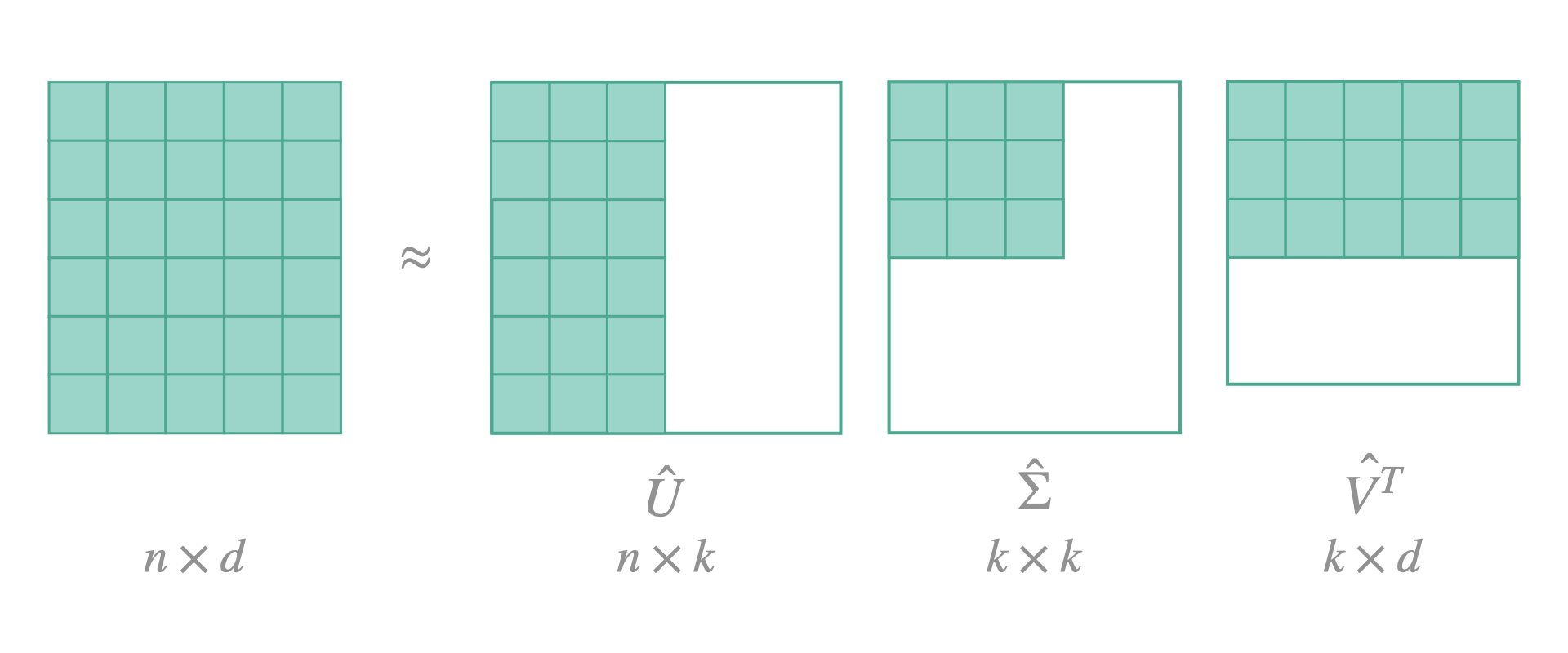
SVD decomposes a weight matrix into three matrices: \(W = U \Sigma V^T\)
Where: - \(U\) contains left singular vectors (output features) - \(\Sigma\) is diagonal with singular values (importance scores) - \(V^T\) contains right singular vectors (input features)
By keeping only the top \(k\) singular values, we approximate \(W\) with two smaller matrices, trading accuracy for compression.
def FC_Decomposer():Decompose fully-connected layers using SVD to reduce parameters
def decompose(
    model:torch.nn.modules.module.Module, percent_removed:float=0.5, # Fraction of singular values to remove [0, 1)
    energy_threshold:float | None=None, # Auto rank: keep this fraction of energy
    data:NoneType=None, # Calibration data for ASVD (None = standard SVD)
    n_batches:int=5, # Number of calibration batches
    layers:list[str] | None=None, # Layer names to decompose (None = all)
    exclude:list[str] | None=None, # Layer names to skip
)->torch.nn.modules.module.Module:
Decompose Linear layers using SVD. Pass data for activation-aware ASVD.
from fasterai.misc.fc_decomposer import FC_Decomposer
from torchvision.models import vgg16

# Load a model with large FC layers
model = vgg16(pretrained=True)

# Decompose, removing 50% of singular values
decomposer = FC_Decomposer()
compressed_model = decomposer.decompose(model, percent_removed=0.5)

# Check parameter reduction
original_params = sum(p.numel() for p in model.parameters())
compressed_params = sum(p.numel() for p in compressed_model.parameters())
print(f"Compression: {original_params/compressed_params:.2f}x")Tests live in nbs/tests/test_fc_decomposer.ipynb.